
English| EUR
Suggested for you
More currencies
Choose a language
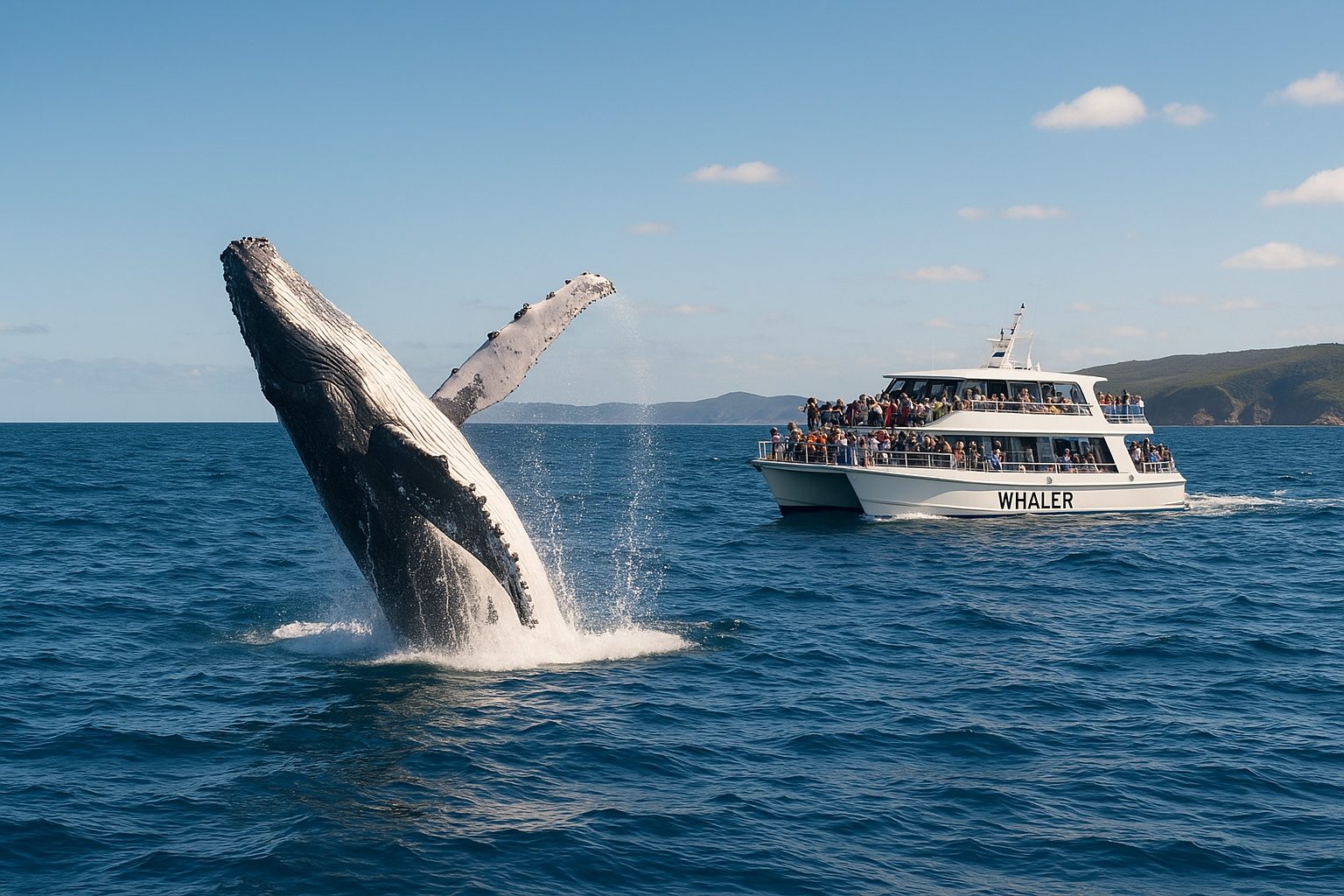
Humpback whales off Hillarys Boat Harbour regularly spend extended periods near whale watching vessels, circling, spy-hopping, and maintaining proximity for hours at a time. The behavior reflects curiosity, social learning, and the species' complex acoustic environment rather than trained responses or feeding opportunities.
Quick answer
Whales swim near whale watching boats for hours primarily due to curiosity, social investigation, and acoustic interest in vessel sounds. Humpback whales, the predominant species off Hillarys during migration season, exhibit complex social behaviors including approach responses to unfamiliar stimuli. Prolonged encounters typically involve juveniles, socializing pods, and resting groups that treat stationary or slow-moving boats as novel environmental features worth investigating through spy-hopping, close passes, and repetitive circling patterns.
A single humpback whale off the Western Australian coast can distinguish between different vessel engine signatures from over three kilometers away, and researchers have documented individuals returning to the same tour boats across multiple days during migration windows. Why do whales swim near whale watching boats for hours becomes clearer when considering the species' intelligence and social structure. Humpback whales possess the largest brain of any animal in the cetacean lineage relative to body size in specific cognitive regions, and their social pods operate on learned behaviors transmitted across generations. When a vessel maintains a stationary position or drifts slowly, whales perceive it as a low-threat object suitable for investigation. Juveniles in particular exhibit bold approach behavior, often initiating contact while adults monitor from a distance. The acoustic signature of idling engines creates a consistent sound marker in the underwater environment, and whales appear to use these signatures as reference points during rest periods or social gatherings. Spy-hopping behavior, where a whale raises its head vertically above the surface to observe the boat and passengers, occurs most frequently during these extended encounters and represents active visual investigation rather than passive drift. The phenomenon intensifies during the northern migration phase between September and November, when humpback pods travel from Antarctic feeding grounds toward breeding areas in the Kimberley region. Hillarys Boat Harbour sits along this migratory corridor, and whales frequently pause their journey for rest stops lasting several hours. During these pauses, the presence of a stationary vessel provides a focal point for pod cohesion, particularly when mothers with calves use the boat's position to teach spatial awareness and surface breathing patterns to young whales. Acoustic playback studies conducted off the Western Australian coast have demonstrated that humpback whales modify their vocal patterns in the presence of vessel noise, often increasing call duration and frequency to maintain pod communication. This vocal adaptation suggests that boats become integrated into the whales' immediate acoustic landscape rather than serving as sources of avoidance. Whale approach behavior varies by individual personality and prior exposure to vessels. First-time encounters with boats often trigger cautious circling at a distance of fifty to one hundred meters, while habituated individuals may approach within ten meters of the hull, occasionally rolling sideways to observe passengers directly. Tour operators departing from 86 Southside Dr, Hillarys WA 6025 report that certain recognizable individuals, identified by unique fluke patterns and dorsal fin scarring, return to the same vessels repeatedly throughout a season, suggesting memory retention and preference formation. The extended duration of these encounters reflects the whales' control over the interaction rather than operator manipulation, and boats that cut engines and allow whales to dictate proximity report the longest engagement periods.
“A single humpback whale can distinguish between different vessel engine signatures from over three kilometers away, and individuals return to the same tour boats across multiple days.”
The prime window for whale watching at Hillarys Boat Harbour spans from September to November, when Humpback whales migrate southward with their calves. Mornings generally offer the calmest sea conditions, which increases the likelihood of observing extended periods of whale activity.
18°C to 24°C; calm waters
The peak season for Humpback whales returning south with calves.
—
Mornings typically feature lower wind speeds and flatter ocean conditions for better sightings.
16°C to 20°C; variable
Southern Right whales are occasionally spotted alongside early-season Humpback movements.
Verdict: The best time to visit is on a weekday morning between September and November for the highest chance of calm waters and active whale encounters.
When whales choose to remain near the boat, proper etiquette ensures the encounter stays on their terms. Respectful behavior maintains the natural interaction that draws whales to linger.
Hillarys Boat Harbour remains accessible to the public at all times, operating on a daily schedule throughout the year.
Hillarys Boat Harbour is located at 86 Southside Dr, Hillarys WA 6025, Australia. The most direct approach is via the Mitchell Freeway for those driving or by using Transperth bus services for public transport.
Mitchell Freeway (State Route 2) to Hepburn Avenue
Transperth Route 423 or 441 to Hillarys Boat Harbour
Direct service to 86 Southside Dr
Arrive between 08:00–08:30 to ensure check-in and parking for scheduled 9:00 AM whale watching departures. Parking at Hillarys Boat Harbour is free.
Everything you need to know about why do whales swim near whale watching boats for hours
When observing cetaceans, you might wonder why do whales swim near whale watching boats for hours. This behavior often stems from natural curiosity, social interaction, or the animal simply resting in the shelter of a vessel's wake. Researchers studying why do whales swim near whale watching boats for hours note that these giants may also be monitoring their surroundings. While observing humpback whales on a Hillarys whale watching tour, you may notice them lingering near the vessel. It is a unique experience to observe these marine mammals, and while scientists continue to study why do whales swim near whale watching boats for hours, the interaction remains a highlight for visitors. Understanding why do whales swim near whale watching boats for hours helps highlight the importance of responsible wildlife tourism. We encourage guests to arrive between 08:00–08:30 for 9:00 AM departures to ensure a smooth boarding process. The entrance fee to access the public areas of Hillarys Boat Harbour is 0 AUD.